
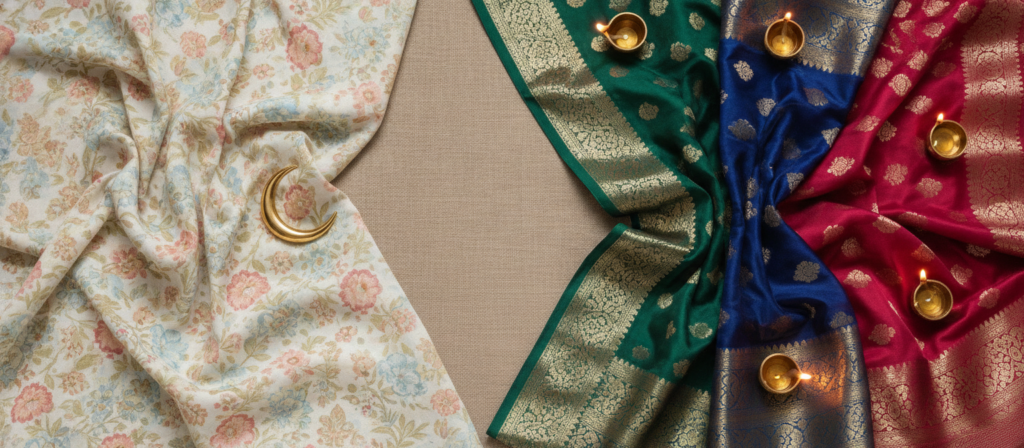
Fashion retail calendars in India and Pakistan run on different rhythms, shaped by which festival dominates each country’s annual shopping cycle. Understanding the difference explains why a Pakistani brand’s biggest collection drop and an Indian brand’s biggest collection drop rarely land in the same month.
Pakistan’s Eid calendar
Pakistani fashion houses build their year around Eid-ul-Fitr and Eid-ul-Adha, with lawn collections in particular timed to launch well ahead of Eid-ul-Fitr, since lawn is a warm-weather fabric and Ramadan and Eid frequently fall during the hotter months. These lawn drops function as the single biggest release event of the year for most major Pakistani labels, with formal and festive lines following separately for wedding season later in the calendar.
India’s Diwali calendar
Indian fashion houses centre their biggest push around Diwali, alongside Navratri and the broader wedding season that follows through winter. Unlike Pakistan’s lawn-specific seasonal fabric logic, Indian festive collections span a wider range of fabric weights, since Diwali falls in autumn across a country with far more regional climate variation than Pakistan’s lawn season assumes.
Bangladesh’s dual calendar
Bangladeshi fashion houses work across both Eid and Durga Puja, reflecting the country’s religious demographics, with Eid collections following a similar early-release logic to Pakistan’s, and Puja collections timed closer to India’s autumn festive calendar. This dual structure means Bangladeshi brands often release major collections twice within a few months of each other, rather than concentrating around one dominant festival.
Why the timing difference matters for shoppers outside South Asia
Someone in Australia, the US, or the UK searching for festive ethnic wear at what feels like the “right” time of year is often working against a calendar built for a different country’s festival than the one they actually have in mind. A Pakistani lawn collection released in February makes little sense to a shopper thinking specifically about Diwali outfits in October, and vice versa. SASTY brings brands from all three countries into one place to compare, preview pieces with virtual try-on, and then buy directly on the brand’s own website, which removes the need to track three separate release calendars just to find something in season.
