
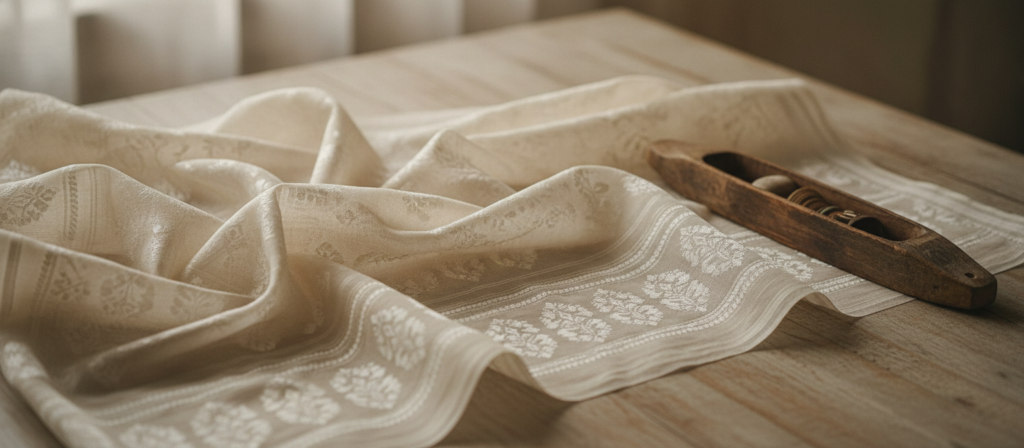
Most South Asian fabric guides available online focus on Indian weaves, Kanjeevaram, Banarasi, Chanderi, largely because India’s textile industry is the largest and most documented of the three countries. Jamdani, Bangladesh’s own signature handwoven textile, gets far less coverage despite being recognised by UNESCO as an Intangible Cultural Heritage craft in its own right.
What makes Jamdani distinct
Jamdani is a handloom weaving technique historically centred on the Dhaka region, traditionally worked in fine cotton or a cotton-silk blend rather than the heavier pure silk used in weaves like Kanjeevaram. The defining feature is the motif itself: patterns are woven directly into the fabric by hand during the weaving process, rather than printed or embroidered afterward, which is what gives a genuine Jamdani saree its characteristic light, almost translucent texture alongside intricate geometric or floral detailing.
How it differs from Indian silk weaves
Kanjeevaram and Banarasi sarees are built around heavy silk and metallic zari thread, designed to hold structure and shine, suited to bridal and formal occasions. Jamdani takes the opposite approach: lightweight, breathable, and historically worn in Bangladesh’s hot, humid climate as both everyday and formal wear depending on the fineness of the weave and complexity of the motif.
Where it fits today
Modern Jamdani has expanded beyond the traditional white-and-off-white palette into a wide range of colours, and beyond sarees into other garment types, while the handwoven motif technique remains the defining trait across all of them. Bangladeshi brands built around handloom weaving traditions, including Aarong and Kay Kraft, both carried on SASTY, work directly with this craft.
Recognising a genuine handwoven piece
A hand-motif Jamdani shows slight, natural irregularity in pattern placement between repeats, since each motif is worked by hand rather than mechanically repeated. A perfectly uniform, machine-printed imitation lacks this variation entirely, which is one of the simplest ways to distinguish authentic handloom Jamdani from a printed lookalike.
